
Vesper
- Proxima Centauri b
- Red Dwarf, M5.5Ve
- 2.3 Million
- 11.2 Earth days
- SupNet ACTIVE
- Jumpgate ACTIVE
Vesper - The Problem Nobody Talks About
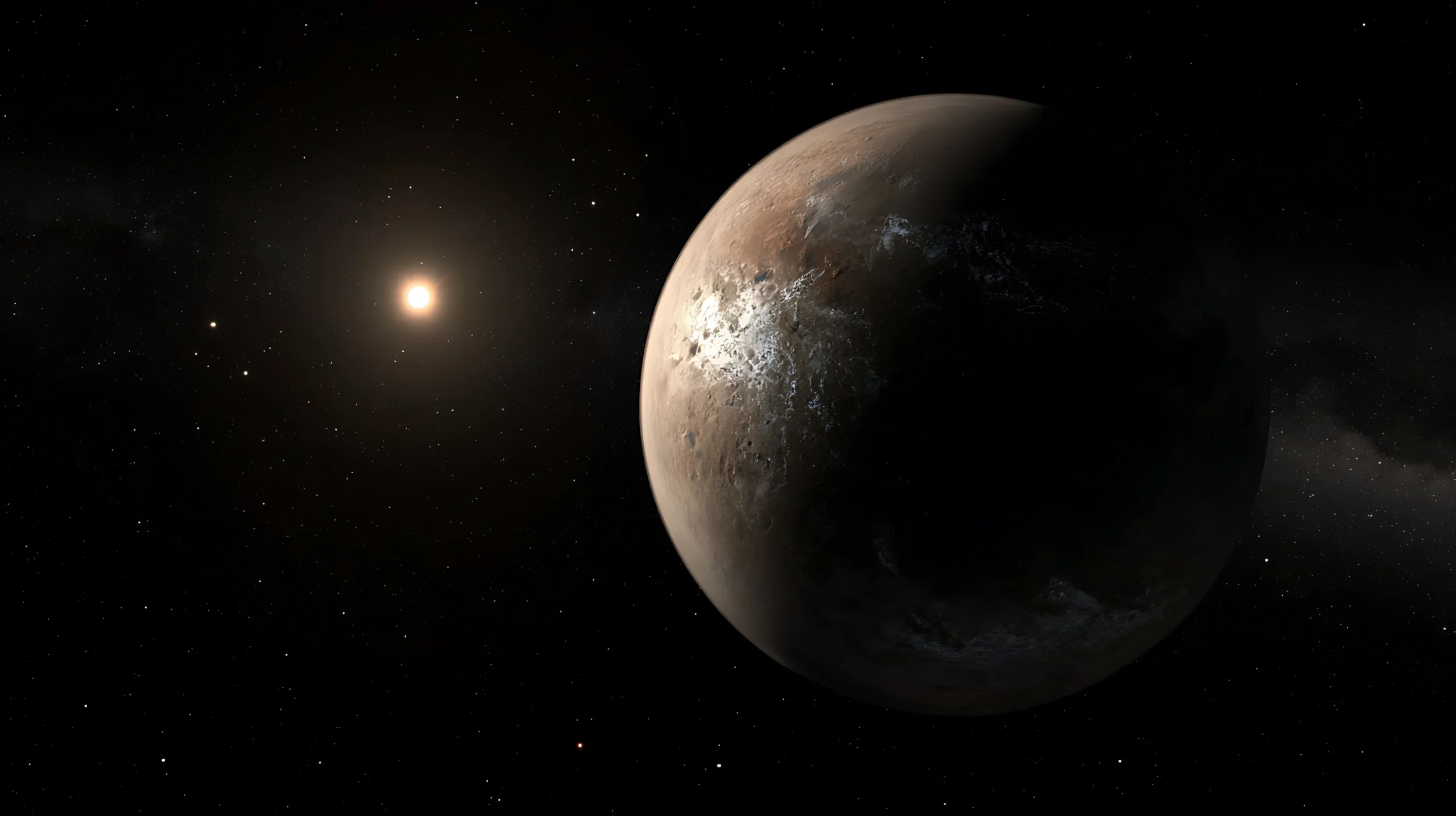
Proxima b should have been humanity's crowning achievement. The closest habitable-zone world. A 4.5-year journey at sub-light, and later, an instant blink through the Jumpgate. The brochures showed rolling green hills under a warm orange sky.
The brochures lied.
The Lock
Proxima b doesn't rotate. One face stares eternally at its dim red sun. The other face hasn't seen light in four billion years. This creates three zones that the terraformers had to work with, and against:
The Dayside - "The Scorch"
Permanent noon. Before terraforming, this hemisphere was a wind-blasted desert where temperatures could spike to 40°C during stellar flares. The atmosphere here rises, creating a permanent low-pressure zone that sucks air from the nightside in a never-ending thermal conveyor.
The Nightside - "The Deep"
Permanent midnight. Pre-terraform, this was a frozen hellscape at -80°C where any atmospheric gases would condense and snow out. The "air glaciers" here were mountains of frozen CO₂ and nitrogen.
The Terminator - "The Ring"
A band roughly 200 kilometers wide where eternal sunset meets eternal sunrise. This narrow strip, the only place where temperature and light exist in something resembling balance, is where humanity built its cities.
Proxima city
The Proximians
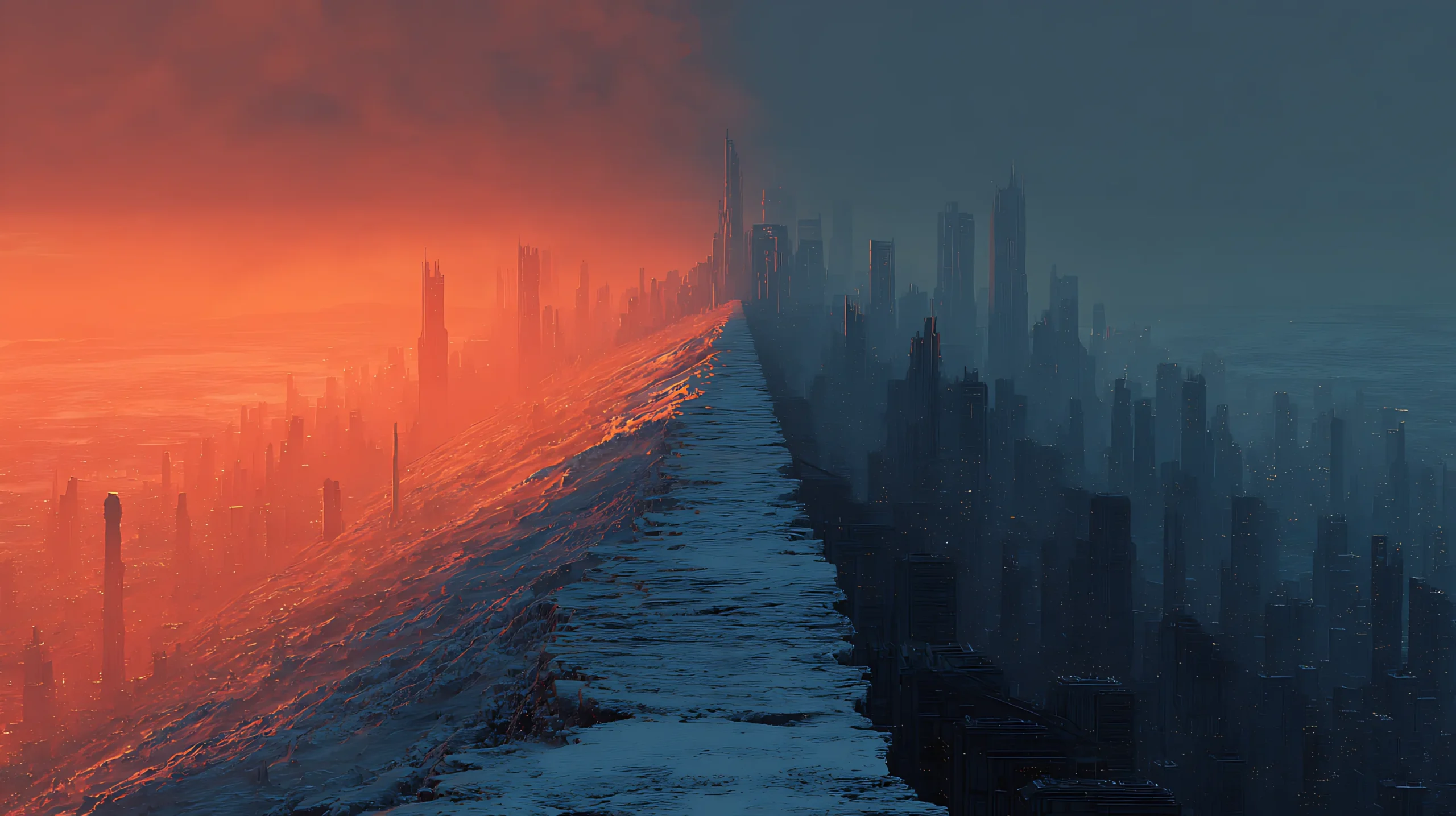
The Colony: "The Ring" Proxima City
The entire human presence on Vesper exists in a band roughly 200 km wide and 12,000 km long, a ring around the planet's waist.
The Geography of Eternal Sunset
Proxima City
The capital. Built in the exact center of the terminator, where the sun hangs permanently at the horizon, swollen and red, taking up 3° of the sky (6 times larger than Sol from Earth).
The Architecture: Because the sun never moves, buildings are designed with permanent shadow in mind. The "sunward" facades are heavily shielded thick walls, the windows deeply set within reinforced bulkheads. The "nightward" facades are glass and gardens. Every building in the city has a bright side and a dark side, creating a distinctive two-faced aesthetic.
The Streets: Run east-west along the terminator. Walking "sunward" for an hour will noticeably increase temperature; walking "nightward" will drop it. Locals navigate by thermal gradient as much as by street signs.
The Wind: The thermal conveyor creates a constant 15-20 km/h breeze from nightside to dayside. Proxima City's famous "Sail Streets" use this wind, automated cargo pods glide down the main thoroughfares on carbon-fiber wings.
The Scorch Stations (Dayside)
Deep into the dayside, temperatures climb past 50°C even after terraforming. But Monolith operates automated mining rigs here, extracting rare minerals from ancient lava flows. Human crews rotate through on 2-week shifts, living in heavily insulated, underground bunkers.
The Scorch is also where the solar farms sit, endless fields of panels drinking in Proxima's infrared bath.
"The Scorch will cook you in four hours and your comm signal in ten minutes. But the ore? The ore's worth it. For now."
The Deep Stations (Nightside)
The nightside is -40°C even after terraforming, and the atmosphere barely holds heat without the sun. But it's stable, predictable, and private.
The Data Vaults: Thalamus operates massive cold-storage server farms here, the eternal dark and cold provide natural cooling.
"The Sleepers": Economy-class cryo-storage facilities for the Sheath-debt cases. Row upon row of frozen minds, awaiting bodies they'll never afford.
The Observatories: The clearest skies in human-controlled space. Astronomers from across the Hegemony come here to stare into the permanent night.
But the Deep is also where people go to disappear. The Hegemony's surveillance networks thin out past the terminator. Smugglers, cultists, and people running from their debts all find refuge in the frozen dark.

They are no longer Earthlings, They are Proximians
Several generations have been born on Vesper and they have changed slightly from their earth-born cousins.
Physical Adaptations
The Eyes: Proximians have pupils that dilate wider than Earth-standard to capture more light. In bright conditions, they squint constantly and wear dark glasses. Some have a faint reflective sheen to their retinas, an engineered tapetum lucidum.
Circadian Drift: Despite the artificial day cycle, many Proximians develop "free-running" sleep patterns; sleeping when tired, waking when rested, with no regard for the 24-hour clock. The concept of "morning" vs. "evening" personality types is meaningless here.
Thermal Sensitivity: Proximians can feel temperature gradients that Earth-humans would ignore. They can tell if they're walking slightly sunward or nightward with their eyes closed.
Psychological Adaptations
Spatial Orientation: Proximians think of space in terms of "sunward/nightward" and "spinward/anti-spinward" rather than compass directions. The sun is always "there." It's the ultimate, unchanging reference point.
Flare Anxiety: Most Proximians carry mild radiation PTSD. The 8-minute warning siren can send entire populations into bunkers. Children are drilled on emergency protocols before they learn to read.
"The Stillness": A form of existential disquiet specific to Vesper. The sun doesn't move. Shadows don't turn. Time passes, but nothing changes. Some Proximians crack, they'll run sunward or nightward until they collapse, desperate to feel something shift in their environment.